
Women in Law
“This is kind of our Hall of Fame. I think that’s awesome.”
~ The Honorable Netti Vogel (admitted 1975)
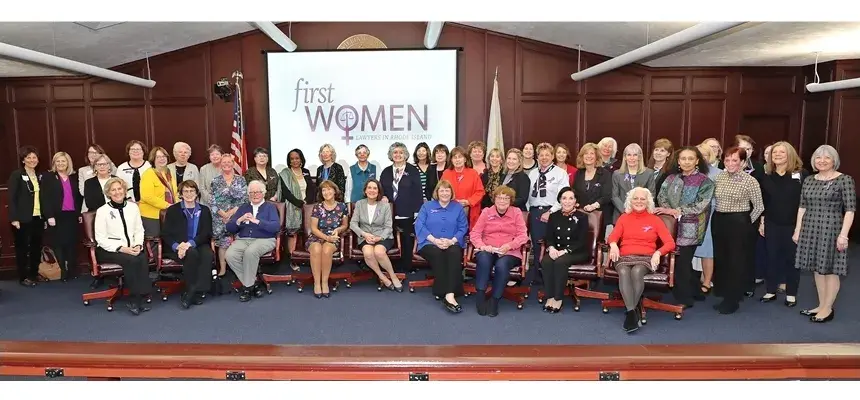
First Women of the Rhode Island Bar
In April 2019, RWU Law honored the first 176 women to join the state’s bar, in an event that drew an overflow crowd celebrating the massive strides made since those early days – while recognizing the work still to be done.
A plaque, prominently mounted in the law school’s second-floor Atrium, includes a listing of all known First Women “and others unknown,” which was painstakingly compiled by RWU Law Library staff. It opens with this preamble:
“Roger Williams University School of Law honors the pioneering First Women of the Rhode Island Bar (1920 to 1979). Their efforts helped establish the rightful place of women in the legal profession and a foundation upon which a more fully inclusive legal profession can be built.”
The plaque was officially unveiled by Judith E. Hodge, who was admitted to the bar in 1965. Hodge was the earliest bar admittee (23rd of 176) of the First Women attending the event.
“It’s been obvious from the start [of the project] that this issue has resonated with many, many people,” Professor Emily Sack noted in her introduction to the ceremony. “This is truly a powerful moment for our legal community, for our law school, and most especially for our students as we focus on the continuing need to achieve gender equity in our profession.”
Speaking for the First Women present, the Honorable Netti Vogel (admitted in 1975), a former RWU Law Board member who did much to help bring the project to fruition, compared the moment to the tear-jerking final scene from the 1992 film “A League of Their Own”, in which the players in later life visit an exhibition about pioneering women in the Baseball Hall of Fame.
“This is kind of our Hall of Fame,” she said. “I think that’s awesome.”
The Dorothy R. Crockett Classroom
On September 10, 2019, RWU Law dedicated a classroom to Dorothy R. Crockett, a Black woman from Providence who became, in 1932, the 7th woman ever admitted to the Rhode Island Bar.
The dedication ceremony featured a powerful keynote by 1st the Honorable Ojetta Rogeriee Thompson of the 1st U.S. Circuit Court of Appeals (who this July became an RWU Law Board member), as well as remarks from Crockett’s daughter Dianne Bartleson, who traveled from Arizona to attend the event.
“It’s hard to imagine the strength, determination, and courage that made Dorothy R. Crockett tick,” noted Providence Journal reporter Katie Mulvaney, herself a student in RWU Law’s Master of Studies in Law program. “In 1932, she joined the Rhode Island bar, despite attending law school amid the Great Depression, despite being a woman, and despite being a woman of color at a time when racism reigned rife in America.”
Led by reference librarian Nicole Dyszlewski, a team of RWU Law librarians discovered Crockett’s legacy while researching the first female lawyers in Rhode Island. They scoured judicial archives and newspaper clips to piece together Crockett’s story.
Judge Thompson, who became the second African American woman to join the Rhode Island bar 1976, said she heard long ago that there had been one other Black woman who led the way before her, but no one seemed to remember any details. “I am grateful to the law school for finally getting the answer to who that wonderful, dynamic woman was; who was a pioneer and upon whose shoulders I stand,” she said. “I am forever grateful.”
The Linn Foster Freedman Seminar Room
In November 2021, cybersecurity lawyer Linn Foster Freedman, a longtime RWU Law board member and philanthropist, was honored with a classroom in her name.
“I think it’s nice to have two women in the mix now,” Freedman said, speaking of her classroom and the Crockett Classroom being added to the several others in the school named for male colleagues. “That feels really great, because it reflects the growing diversity not only of the legal profession, but of the law school itself.”
During her term on RWU Law’s Board, Freedman worked tirelessly to increase fundraising for RWU Law. She is now an influential supporter of the law school on the RWU Board of Trustees.
As a partner at Robinson & Cole LLP, where her practice focuses on data privacy and security, Freedman has encouraged the hiring of RWU Law alumni. She has also volunteered her time teaching Privacy Law as an adjunct for several years.
“What I really admire about Linn is that she is among the leaders of the bench and bar, but is still just as willing to spend a fall Saturday with her husband and friends participating in the Law Alumni Golf Tournament, raising money for scholarships for rising 2Ls,” said former Dean Michael J. Yelnosky. “She not only pays to play but she usually goes home with a bunch of stuff she does not need—because she buys so many raffle tickets the odds are stacked in her favor. She is truly a great friend of the law school.”