
RWU Law Students Gain Experiential Learning Through Rhode Island Eviction Protection Project
Pro bono program at Roger Williams University School of Law provides hands-on legal experience while supporting tenants facing eviction.
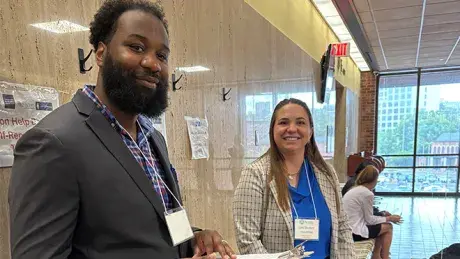
BRISTOL, R.I. – As Rhode Island continues to face an affordable housing crisis, Roger Williams University School of Law is addressing the issue through experiential learning that connects students with real clients and community needs.
Across the state, many renters spend more than half of their income on housing, often forcing difficult trade-offs with essential needs such as food and health care. In response, the School of Law created the Eviction Protection Project, a pro bono initiative that allows students to gain hands-on legal experience while supporting tenants at risk of eviction.
The Eviction Protection Project initially launched in September 2021 following the COVID-19 pandemic, when many Rhode Island residents faced potential eviction after the expiration of pandemic-related protections. The program, led by Eliza Vorenberg, Clinical Professor of Law and director of pro bono and community partnerships, is able to continue thanks to funding from the U.S. Deptartment of Housing and Urban Development to train students to staff the tenant help desk at R.I. District Court.
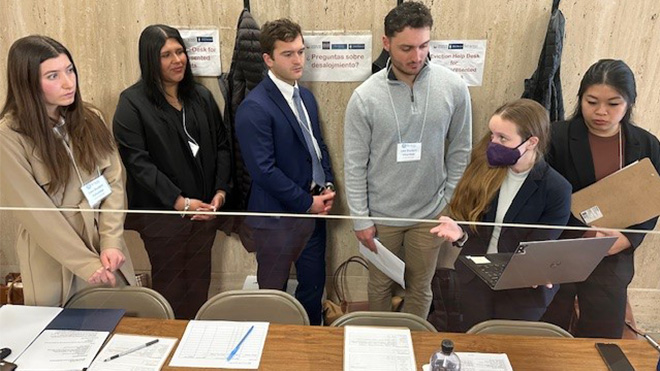
Students volunteer at the Eviction Help Desk in District Court, where they assist tenants under the supervision of legal services attorneys.
“They’re learning how to work under the supervision of legal services attorneys in a triage setting and how to collaborate with their supervisors and law student peers in making the Eviction Help Desk a supportive and welcoming place for the tenants we serve,” Vorenberg said.
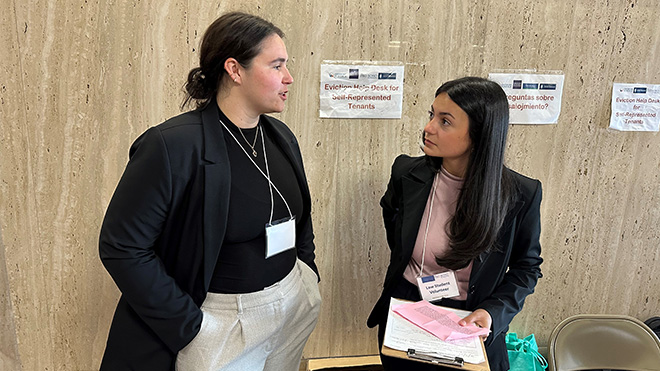
In partnership with Rhode Island Legal Services, Inc. and the Rhode Island Center for Justice, students conduct client interviews and eligibility screenings for low-income tenants facing eviction. They also serve as court navigators, helping tenants better understand and move through the legal process.
Since its inception, the project has contributed to numerous outcomes that have delayed or prevented evictions. Students also collaborate with HousingWorks RI, a data partner that provides insights into the state’s housing market and affordability challenges.
Brenda Clement, executive director of HousingWorks RI, described Rhode Island’s housing market as “challenging at best.” She noted that wages have not kept pace with rising housing costs.
“We’ve been under-producing for many, many years, particularly affordable units,” Clement said. “This is a really big challenge for economic growth and developing a workforce, but also, just in the general health and educational outcomes of individuals.”
Limited housing availability often forces residents to make difficult financial decisions, affecting access to transportation, health care, and education.
For students, the experience offers both professional and personal growth. Georgia Balkun, a Juris Doctor candidate from Cape Coral, Fla., has worked on the project for two years and serves as a student leader.
“Observing and learning from them has taught me a lot, not just about practical skills but also about how to advocate effectively for clients,” Balkun said.
Initially interested in real estate law, Balkun said the experience broadened her understanding of the field beyond property transactions.
“Above all, this experience has been incredibly rewarding on a personal level. The tenants we help are always so grateful, and seeing the difference we make for them is something I’ll never forget. I remember running into a tenant about a month after I had helped her, and she actually got emotional thanking me for helping her get more time to move out. Another time, my supervising attorney and I were able to help a disabled veteran stay in his home and connect him with Operation Stand Down for additional support. Experiences like these have shown me why this work is so important and have had a real impact on how I envision my legal career.”
Kirsten Taylor, a Juris Doctor candidate from South Salt Lake, Utah, and a student leader for the project, emphasized the importance of pro bono service in the legal profession.
“Working with individuals confronting the immediate risk of displacement has convinced me that pro bono service should not stand apart from professional identity. This service is one of the clearest ways attorneys can fulfill their obligation to improve the quality of justice,” Taylor said.
The experience also highlighted the complexity of the legal system for those unfamiliar with it.
“This tension reinforced my belief that professionalism requires patience, candor, and respect for the person whose life exists behind the file.”
Through the Eviction Protection Project, Roger Williams University law students are developing practical legal skills while making a meaningful impact in Rhode Island communities – demonstrating how experiential learning can bridge classroom education with real-world application.