
Passionate Changemakers: RWU Law Students Address Rhode Island’s Housing Crisis
Roger Williams University’s Housing Policy Clinic celebrates the hard work of law students, representatives, and coordinators involved with the first Housing Advocacy Clinic Showcase.
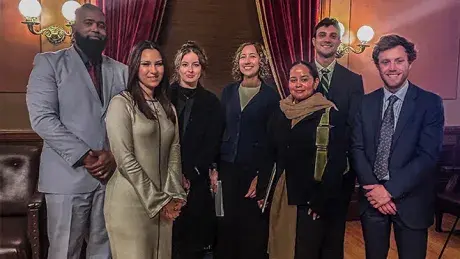
BRISTOL, R.I. – A group of paper houses and apartment complexes with a warm light inside greeted attendees at the door inside one of Rhode Island’s State House rooms. It was a symbol of what everyone there was fighting for: “a neat, well-lit place” as a right for all in Rhode Island to have. At the inaugural RWU Law Housing Advocacy Clinic Showcase last month, the struggles of condominium owners, rising housing fees, lack of space, and the fight for stability were discussed, featuring the voices of law students who spent the last semester diving deeply into one of the state’s most urgent and challenging housing issues.
Rhode Island House Speaker K. Joseph Shekarchi delivered an inspiring speech to open the event. “The things we are doing here, and with everybody’s help in the room, we are making a difference, and people are noticing,” said Shekarchi. “We need the young minds of today learning and figuring it out and helping every level of housing across the board.”
The showcase included a tribute to Housing Commission Coordinator Raymond Neirinckx, whose more than 25-year career in Rhode Island has shaped policies, mobilized financial institutions, and protected low- and moderate-income residents. Neirinckx was honored with the first-ever “LightKeeper Award” from the Housing Policy Clinic, recognizing those who have tirelessly worked to fight for housing justice.
“We stand on the shoulders of those who come before us, and it’s always important to recognize this community of practice,” says Neirinckx. “This is what I’ve always tried to express, and I see so many people that I’ve been privileged to work with and work for.”
The class, taught by Professor of Law Monica Teixeira de Sousa, began so students could gain experience documenting and reforming the outdated legal framework that governs many Rhode Islanders. The semester was shaped by researching Rhode Island’s condominium laws, interviewing experts, and gathering accounts from residents across the state. While doing this, students worked hand-in-hand with Housing Network of RI, Neighbors Welcome! RI, and the RI Center for Justice, allowing them to become familiar with these organizations and the legislators who are advocating for housing reform.
“The class discussions were amazing, it was really interactive,” said Kevin Lowther, a third-year law student from Westerly, R.I. “We talked through a lot of issues, and brought in so many people from the community. We learned from everybody.”
Students were split up into groups of two, each tackling a housing crisis issue that is currently plaguing residents of Rhode Island. Melanie Baez, a third-year law student from Providence, R.I., and Autumn Sheldon, a third-year law student from Dalton, Mass., researched issues relating to housing stability and access to justice issues. They highlighted the financial strain caused by rent increases, the impact of eviction records on families, the education of children, employment, and the physical and mental well-being of those impacted.
Lowther and Casey Rivera, a third-year law student from Providence, R.I., discussed impediments to housing production due to excess parking. The pair proposed a parking reform legislation, which caps mandatory minimum parking requirements, emphasizing the importance of using land for housing rather than parking.
Lowther said the class has inspired him to explore pursuing legislative work in the future. “I want to continue to work on housing administration, continue to fight for laws that are going to put more Rhode islanders in houses, and pro-bono work with tenants,” said Lowther.
The last group was comprised of Georgia Balkun, a third-year law student from Cape Coral, Fla., and Adam Speakman, a third-year law student from Warren, R. I., who spoke on deed-restricted condominiums. Under current R.I. law, condominium associations are not required to offer any kind of payment flexibility, causing disproportionate burdens on condominium owners.
After the student presentations concluded, RWU School of Law Dean Gregory Bowman addressed the attendees, reflecting on the meaning behind the event.
“This work is very important,” said Bowman. “It’s an example of how our students are the lawyers and leaders of the future. They are the changemakers of our society. When we do our jobs right, we are agents of social change, and it is important to keep that in mind at this particularly important time in our history.”
In his remarks, Dean Bowman announced that Neirinckx will be donating 73 notebooks of his work to the RWU law library – a unique historical record that will become part of the school’s permanent collection.