
Ahmir Kenyatta L’27: Defining His Own Path as a 2L Transfer

Long before he stepped into a law school classroom, Ahmir Kenyatta L’27 understood the power of advocacy. As a child who endured abuse and later, as a teenager in foster care, he learned that the systems meant to protect him did not always work. Out of necessity, he took matters into his own hands at an early age, learning how the law operated by reading statutes, studying procedure, and filing motions on his own behalf. Education, he says, became his path forward. “Nelson Mandela says education is emancipation,” Kenyatta says, “and I couldn’t be a clearer example of how true that is.”
After earning his high school equivalency, he completed an associate degree and graduated cum laude with a bachelor’s degree in criminal justice, all while working full time in security and loss prevention roles. Later, he earned a master’s in human resources and employment law and would go on to teach at Southern New Hampshire University, a full-circle moment that reinforced his belief that education creates opportunity.
He built a career in human resources, rising to executive leadership before the age of 30. By any conventional measure, he was successful. “I did very well before law school,” Kenyatta says. “But it still wasn’t fulfilling. The money wasn’t fulfilling. I needed to get this J.D. I needed to pursue changing the world.”
But his path to RWU Law was not linear.
After applying to more than twenty law schools, Kenyatta faced a difficult reality: without a strong LSAT score, his options were limited. He accepted the opportunity available to him but quickly realized it was not the right fit.
He completed his first year, retook the LSAT, and raised his score. When he was admitted to RWU Law, the decision was immediate. He saw an environment that rewarded initiative, and the school’s emphasis on belonging and practical advocacy resonated deeply with him.
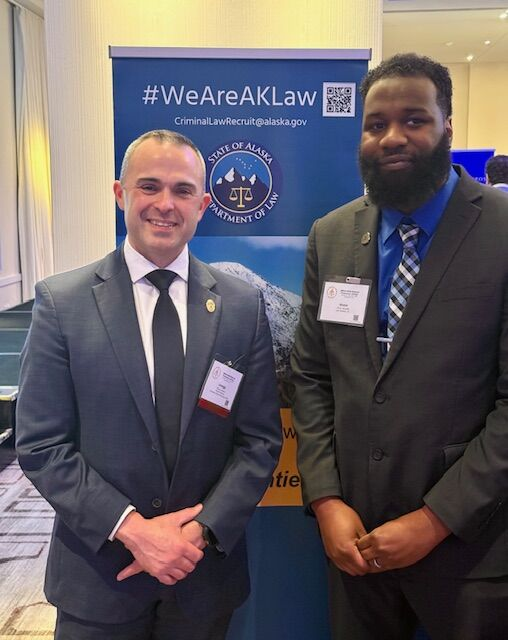
Since arriving for his 2L year in the fall, Kenyatta has been deliberate about building the skills and experience necessary to pursue his goal of becoming a Special Victims Unit prosecutor. He serves as Secretary of the Law Student Division of the Federal Bar Association, recently attended the National District Attorneys Association Prosecutors Advocacy Conference in Washington, D.C., and will spend his summer as a Legal Extern in the Office of General Counsel and Institutional Compliance at Touro University. He is also a Child Protection Intern with the Rhode Island Department of Children, Youth and Families, and this semester is serving as a Rule 9 Student Attorney at Rhode Island Legal Services (RILS) assigned to the Housing Law Center.
He says RWU Law’s emphasis on experiential learning, mentorship, and community engagement has allowed him to shape his legal education in alignment with that purpose. He is especially grateful for the opportunity to learn alongside peers who bring diverse perspectives to the law, as well as for the accessible faculty and staff who have supported him on his journey to becoming an attorney. “I’m getting practical experience that I can deliver when I leave and pass the bar,” he says. “I’m so thankful that creating practice-ready attorneys is part of our mission.”
Kenyatta remains grounded in the belief that adversity does not determine trajectory. He knows firsthand what it means to fight – to push through instability and to stand up for himself when few others would. He believes his journey reflects the power of persistence and the ability to shape your own path.
“It doesn’t matter what adversity you face,” he says. “If you have the perseverance and the grit, you can overcome those circumstances. I think I’m a testament to that.”