
A Quiet Success Story: RWU Law’s Enduring Partnership with the Center for Justice
As the independent nonprofit marks ten years of service, RWU Law reflects on a collaboration that has expanded public‑interest opportunities for students and alums.
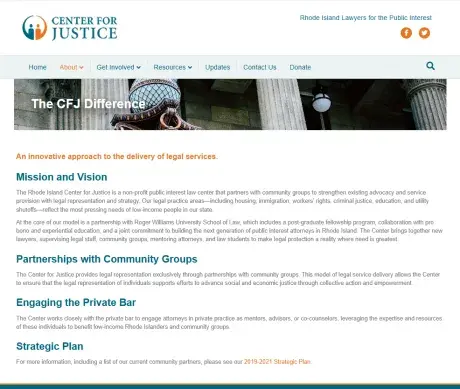
As Roger Williams University School of Law reflects on its public-interest legacy, one theme emerges: the steady, often understated role the school has played in the growth of the Rhode Island Center for Justice (CFJ). This milestone presents a meaningful moment to reflect on a partnership that has shaped both institutions and enhanced access to justice across Rhode Island.
A Vision Rooted in Collaboration
The Center for Justice opened in 2015 after years of planning by its founders, attorneys Miriam Weizenbaum and Bud DeLuca, who sought to create a nonprofit that would expand Rhode Island's civil legal services landscape while preparing the next generation of public-interest lawyers.
RWU Law quickly became a natural partner. Then‑Dean Michael Yelnosky recognized how closely the Center's mission aligned with the law school's longstanding commitment to serving underrepresented communities. From the start, the Center launched a fellowship program exclusively for RWU Law graduates. That program has since become a reliable pathway into meaningful public‑interest work for dozens of alums.
A Training Ground for Public‑Interest Lawyers
Over the past decade, the Center has welcomed RWU Law fellows, externs, summer interns, Alternative Spring Break students, and many volunteers. Students and alums have provided direct client service in areas such as housing, immigration, workers' rights, education, prison conditions, and utility shutoffs. Their work has often taken place in a resource‑limited environment where every hour of service matters.
When Natalia Friedlander, now a member of the RWU Law faculty, joined the Center in 2017, the two permanent staff attorneys were Executive Director Jennifer Wood and John Willumsen‑Friedman. Professor Friedlander became a full‑time staff attorney in 2018, at which point the Center had grown to four attorneys. She recalls that the Center “relied on its partnership with the Law School to punch well above its weight,” offering students hands‑on advocacy experience while expanding the Center’s capacity to serve thousands of community members.
Today, the Center employs ten attorneys, seven of whom are graduates of RWU Law. It continues to work closely with the law school's Office of Career Development on its fellowship hiring cycle.
Independent Nonprofit, Enduring Partnership
Although RWU Law played a key role in the Center’s early development, the Rhode Island Center for Justice has always been an independent nonprofit with its own governance, leadership, and funding.
The law school's relationship with the Center today is one of support and strategic alignment. RWU Law faculty serve on the Center's board, alumni work as staff and fellows, and students continue to learn alongside experienced public‑interest attorneys. Professor Michael Yelnosky and Professor Eliza Vorenberg currently serve on the Center’s Board of Directors, continuing a long tradition of RWU Law engagement in the Center’s mission. The Center’s direction, litigation strategy, and organizational priorities, however, remain entirely its own.
Under the leadership of Executive Director Jennifer Wood, the partnership has continued to evolve, grounded in shared values and a mutual commitment to expanding access to justice.
Looking Ahead
As the Center for Justice continues its work as an independent force for civil legal rights, RWU Law remains proud of the alums, faculty, and students who contribute to its mission. The partnership, built on respect and a shared sense of purpose, stands as one of the law school's most meaningful public‐interest achievements.
A decade in, the story of RWU Law and the Center for Justice reflects something larger: a sustained commitment to community impact, a belief in the power of legal education to advance justice, and a collaboration that continues to strengthen Rhode Island’s public‑interest landscape.